
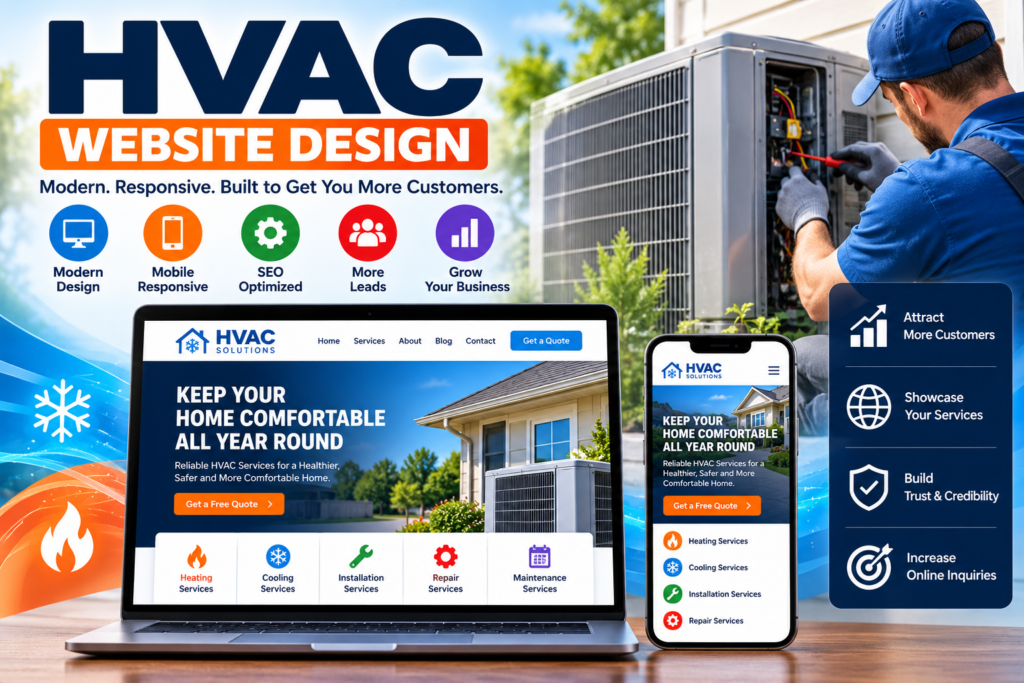
For heating, ventilation and air conditioning businesses, a website is more than an online brochure. It is an important tool for attracting potential customers, showcasing services and converting website visitors into enquiries and booked appointments.
Whether you provide air conditioning installation, furnace repairs, heating maintenance or commercial HVAC services, your website should make it easy for customers to understand what you offer and contact your business.
This is where effective HVAC Website Design Features make a difference. A well-designed HVAC website combines clear navigation, mobile responsiveness, strong calls to action, service information and local SEO elements to help turn visitors into potential customers.
However, an attractive design alone does not guarantee more leads. Your website must also build trust, answer customer questions, load quickly and provide a straightforward way to request a quote or schedule a service.
In this guide, we explore 10 essential HVAC Website Design Features that can help improve user experience, strengthen your online presence and support lead generation.
Why Do HVAC Website Design Features Matter?
Customers looking for HVAC services often need a solution quickly. They may be searching for an air conditioning repair, a heating system replacement or routine maintenance before the next season.
If your website is confusing, slow or difficult to use on a mobile device, potential customers may leave and contact another company.
Effective HVAC Website Design Features help businesses address these problems by making essential information easy to find and enquiries easy to submit.
A strong HVAC website should help visitors answer four important questions:
- What HVAC services does the company provide?
- Does the company serve my area?
- Can I trust the business?
- How can I request service or a quote?
When your website answers these questions clearly, it creates a better experience for potential customers and supports your wider marketing efforts.
10 Essential HVAC Website Design Features That Help Generate More Leads
1. Mobile-Friendly Website Design
One of the most important HVAC Website Design Features is mobile responsiveness.
Many customers use smartphones to search for local HVAC contractors, particularly when an air conditioning or heating system stops working unexpectedly.
Your website should automatically adapt to different screen sizes so visitors can read content, browse services and contact your business without unnecessary zooming or scrolling.
A mobile-friendly HVAC website should include:
- Readable text
- Clear navigation
- Properly sized buttons
- Easy-to-complete contact forms
- Clickable phone numbers
- Fast-loading images
- A layout that works across mobile, tablet and desktop devices
For example, a customer searching for emergency AC repair should be able to find your phone number and service information quickly.
Lead generation benefit: A responsive design removes friction and makes it easier for mobile visitors to contact your business.
2. Clear Calls to Action
A website can attract visitors but still generate few leads if customers do not know what to do next.
Calls to action (CTAs) guide visitors towards a specific action, such as requesting a quote, calling your office or booking a maintenance appointment.
Useful HVAC website CTAs include:
- Request a Free Quote
- Book HVAC Service
- Schedule AC Repair
- Call for Service
- Get an Installation Estimate
- Contact Our HVAC Team
Place relevant CTAs on your homepage, service pages and other important landing pages.
Use clear, action-oriented language and make sure each button leads to the correct destination.
Avoid filling every section with competing buttons. Instead, choose a primary action for each page and use supporting CTAs where appropriate.
Lead generation benefit: Clear calls to action help turn interest into enquiries by showing visitors the next step.
3. Click-to-Call Phone Numbers
For many HVAC companies, phone calls are an important source of new business.
A visible, clickable phone number allows mobile users to contact your team without copying or manually entering the number.
Consider placing your phone number in:
- The website header
- The mobile navigation menu
- The contact page
- Relevant service pages
- The footer
If your business offers emergency services, clearly explain the actual hours and areas covered. Do not advertise 24/7 availability unless you genuinely provide it.
A click-to-call feature is simple to implement but can make the customer journey significantly easier.
Lead generation benefit: It reduces the steps required for a potential customer to speak with your business.
4. Dedicated HVAC Service Pages
A common website mistake is listing every service on one generic page.
Instead, create dedicated pages for your main services, such as:
- Air conditioning installation
- AC repair
- Heating system repair
- Furnace installation
- Heat pump services
- HVAC maintenance
- Commercial HVAC services
- Indoor air quality solutions
Each page should explain the service, the problems it addresses, what customers can expect and how to request assistance.
For example, an AC repair page should focus on common air conditioning problems, your repair process, service availability and the next step for contacting your business.
Dedicated pages can also help search engines understand the services your company provides.
Lead generation benefit: Relevant service pages can attract more qualified visitors and give them information tailored to their needs.
5. Local SEO and Service Area Information
HVAC businesses often depend on customers within a particular geographic area. Your website should therefore make your service locations clear.
Include accurate information about your business location, contact details and the towns or neighbourhoods you genuinely serve.
Useful local SEO elements include:
- A clear contact page
- Consistent business name, address and phone number where applicable
- Relevant service-area pages
- Accurate business hours
- An embedded map where appropriate
- A properly maintained Google Business Profile
- Relevant local business structured data
If you serve multiple towns, create useful location pages with genuinely relevant information instead of publishing nearly identical pages that only change the place name.
Local SEO can help search engines understand where your services are available, although rankings are never guaranteed.
Lead generation benefit: Clear service-area information helps potential customers establish whether your company can serve their location.
6. Customer Reviews and Trust Signals
Hiring an HVAC contractor involves trust. Customers want to know that the business is experienced, reliable and capable of completing the job properly.
Your website can help build confidence by displaying genuine customer feedback and verifiable credentials.
Consider including:
- Genuine customer testimonials
- Links to independent review profiles
- Relevant trade qualifications
- Applicable licences
- Professional memberships
- Manufacturer accreditations
- Insurance information where relevant
- Case studies or completed projects
Make sure every claim is accurate and current. Never create fake reviews or display certifications that your business does not hold.
You can also include project photographs and short explanations of the work completed, provided you have permission to use the material.
Lead generation benefit: Credible trust signals can reduce uncertainty and help visitors feel more comfortable making an enquiry.
7. Fast Website Loading Speed
Website speed is another important element of effective HVAC Website Design Features.
Visitors may leave a website if pages take too long to load, particularly when they need information urgently. Slow pages can also make forms, navigation and other interactive elements frustrating to use.
To improve performance:
- Compress images before uploading them.
- Use appropriately sized image files.
- Avoid unnecessary animations.
- Remove unused plugins and scripts.
- Choose reliable website hosting.
- Enable suitable caching.
- Minimise unnecessary third-party tools.
- Test important pages on mobile devices.
Google’s Core Web Vitals provide useful measurements of loading performance, responsiveness and visual stability.
For WordPress websites, including sites built with Elementor, review the impact of large images, excessive widgets and unnecessary plugins before adding more design elements.
Lead generation benefit: A faster website creates a smoother browsing experience and helps visitors reach important information with less friction.
8. Simple Contact and Quote Request Forms
Contact forms are essential for visitors who prefer to submit an enquiry rather than make a phone call.
However, a form with too many fields can discourage people from completing it.
A basic HVAC quote form may ask for:
- Name
- Phone number or email address
- Required service
- Property postcode or service location
- Brief description of the problem
Only request information that you genuinely need at the initial enquiry stage.
Use clear field labels, helpful error messages and a confirmation message after successful submission. Test the form regularly to ensure that enquiries reach the correct inbox or CRM.
If you collect personal information, provide an appropriate privacy notice and handle the data in accordance with applicable privacy requirements.
Lead generation benefit: A short, reliable form gives visitors another convenient way to request service.
9. Helpful HVAC Content and FAQs
Customers often search online before choosing an HVAC contractor. They may want to understand repair options, maintenance requirements, installation costs or the differences between heating and cooling systems.
Useful content can answer these questions while demonstrating your company’s knowledge.
Consider publishing articles and guides about:
- Signs an air conditioner needs repair
- How often HVAC systems need maintenance
- When to repair or replace a heating system
- Factors that affect AC installation costs
- Heat pump maintenance tips
- Ways to improve indoor comfort
- Questions to ask before hiring an HVAC contractor
Add relevant FAQs to service pages to address common customer concerns. Keep the answers accurate, practical and easy to understand.
Avoid publishing generic articles simply to include keywords. Content should solve real customer problems and help visitors make informed decisions.
Lead generation benefit: Helpful content can attract relevant organic traffic and move potential customers closer to contacting your business.
10. Lead Tracking and Conversion Analytics
The final feature is measurement.
Without tracking, it can be difficult to understand which website pages generate enquiries and where visitors leave the customer journey.
Useful measurement tools and techniques include:
- Google Analytics 4
- Google Search Console
- Form submission tracking
- Click-to-call event tracking
- Campaign tracking parameters
- CRM lead records
- Landing-page performance reports
Track meaningful actions such as completed quote requests and calls initiated through your website. Where possible, distinguish between a button click and a genuine completed enquiry.
Review the data regularly to identify which service pages attract visitors, which CTAs perform well and where improvements may be needed.
Follow applicable consent and privacy requirements when implementing analytics and advertising tools.
Lead generation benefit: Conversion tracking helps you make decisions based on actual website performance instead of relying only on assumptions.
HVAC Website Design Features Comparison Table
The following table summarises how each feature supports your website’s lead-generation goals.
| Website feature | Main purpose | Potential lead-generation benefit |
|---|---|---|
| Mobile-responsive design | Improve mobile usability | Makes contacting the business easier |
| Clear CTAs | Guide visitors to an action | Encourages enquiries |
| Click-to-call numbers | Simplify phone contact | Reduces contact friction |
| Dedicated service pages | Explain individual services | Attracts more relevant visitors |
| Local SEO information | Clarify service areas | Helps reach local customers |
| Genuine reviews | Build trust | Reduces uncertainty |
| Fast loading speed | Improve performance | Creates a smoother experience |
| Simple contact forms | Collect enquiries | Supports quote requests |
| Helpful content | Answer customer questions | Attracts and informs prospects |
| Analytics and tracking | Measure conversions | Identifies opportunities for improvement |
How to Improve an Existing HVAC Website
You do not necessarily need to rebuild your entire website to improve lead generation.
Start by reviewing the customer journey and identifying the most important problems.
Step 1: Test the Website on a Mobile Phone
Check whether the navigation, phone number, forms and CTAs are easy to use.
Step 2: Review Your Homepage
Make sure visitors can quickly understand your services, service areas and primary contact option.
Step 3: Improve Your Main Service Pages
Add useful details, relevant FAQs, accurate service information and clear next steps.
Step 4: Check Website Performance
Use performance testing tools to identify slow-loading images, scripts or other technical problems.
Step 5: Test Every Contact Method
Submit a test form, check telephone links and verify that enquiry notifications are delivered correctly.
Step 6: Measure Results
Track completed enquiries and review the pages that contribute to them. Use the results to guide further improvements.
Common HVAC Website Design Mistakes to Avoid
Even a visually attractive website can struggle to generate leads if important elements are missing.
Avoid these common mistakes:
Unclear messaging: Visitors should quickly understand what your company does.
Hidden contact details: Do not make customers search through multiple pages to find your phone number.
Too many pop-ups: Intrusive pop-ups can interrupt the user journey, particularly on mobile.
Generic service pages: Explain your actual services rather than relying on vague descriptions.
Slow-loading images: Large photographs can affect performance if they are not optimised.
Unverified claims: Avoid unsupported statements about experience, certifications or customer results.
Untested forms: A broken enquiry form can cause you to miss potential business.
No performance measurement: Without tracking, you may not know which improvements are working.
Final Thoughts: Which HVAC Website Design Features Matter Most?
The most effective HVAC Website Design Features combine usability, trust, relevant content and a straightforward enquiry process.
Mobile responsiveness, clear calls to action, click-to-call phone numbers, dedicated service pages, local SEO, genuine reviews, fast loading speeds, simple forms, helpful content and conversion tracking all have a role to play.
However, adding features alone does not guarantee more leads. Your website should be designed around your customers’ needs, tested regularly and improved using real performance data.
Start with the essentials: make your services clear, show customers how to contact you, ensure the website works properly on mobile and verify that every enquiry method functions correctly.
Ready to Improve Your HVAC Website?
Review your current website against these 10 HVAC Website Design Features and identify the changes that would make the biggest difference to your customers.
Prioritise mobile usability, clear service information, trustworthy business details and a simple way to request a quote. Then measure completed enquiries to understand which improvements are delivering value.
Build a more useful HVAC website, make it easier for customers to contact your business and turn your online presence into a stronger lead-generation channel.
FAQs About HVAC Website Design Features
What are the most important HVAC Website Design Features?
The most important features include mobile responsiveness, clear calls to action, visible contact details, dedicated service pages, local SEO information, genuine reviews, fast loading speed, simple forms and conversion tracking.
How can an HVAC website generate more leads?
An HVAC website can support lead generation by making services easy to understand, answering customer questions, building trust and providing convenient ways to call or submit an enquiry.
Why is mobile-friendly design important for HVAC companies?
Customers frequently use smartphones to find local contractors. A mobile-friendly website makes it easier to read service information, call the business and complete contact forms.
Should an HVAC company have separate service pages?
Yes, dedicated pages for services such as AC repair, heating installation and HVAC maintenance can provide more relevant information and support search visibility for specific customer needs.
Does website speed affect HVAC lead generation?
Slow pages can frustrate visitors and make it harder to complete enquiries. Improving performance can create a smoother user experience, although it does not guarantee additional leads.
What should an HVAC quote form include?
A simple form may request a name, contact details, required service, service location and a short description of the customer’s needs. Only collect information that is necessary at the enquiry stage.
How does local SEO help an HVAC website?
Local SEO helps search engines understand the company’s services and service areas. Accurate business information and useful location-specific pages can help connect relevant searchers with the business.
How can an HVAC company measure website leads?
Businesses can track completed forms, relevant phone-call events, campaign performance and CRM records using suitable analytics tools. Tracking should comply with applicable privacy and consent requirements.
Do customer reviews help HVAC websites convert visitors?
Genuine reviews can help potential customers assess a business’s reputation and reliability. Their impact depends on the customer’s needs, the credibility of the reviews and the overall website experience.
How often should an HVAC website be updated?
Review the website regularly for outdated service information, broken forms, technical issues, inaccurate business details and opportunities to improve content or performance. Major changes should be guided by customer feedback and conversion data.