
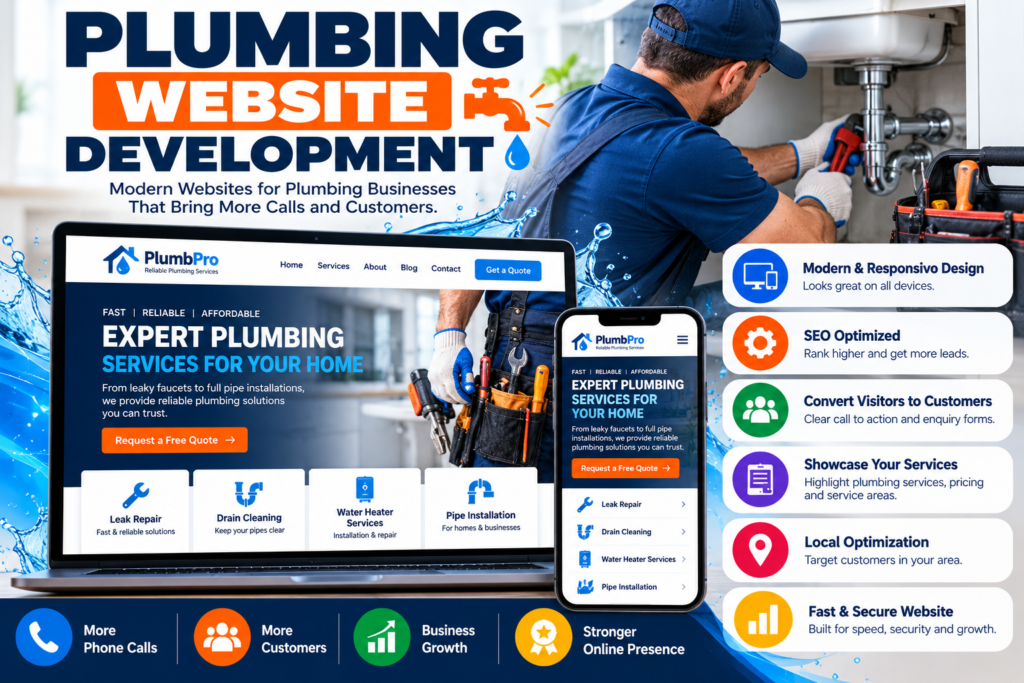
In today’s competitive digital market, having a professional website is essential for plumbing businesses that want to attract new customers and grow their services. Whether you are an independent plumber or manage an established plumbing company, your website can help potential customers discover your services, build trust in your business and request a quote.
Effective Plumbing Website Development goes beyond creating an attractive design. It involves building a fast, mobile-friendly and search-engine-optimised website that guides visitors towards taking action, whether that means calling your business, booking an appointment or submitting a service enquiry.
A well-developed plumbing website should answer customers’ questions, highlight your expertise and make it easy to find the right service. From emergency plumbing pages to customer reviews and clear contact details, every element should support your business goals.
In this guide, we will explore how to build a high-converting plumbing website, the essential features to include and the strategies that can help turn website visitors into potential customers.
What Is Plumbing Website Development?
Plumbing Website Development is the process of planning, designing and building a website specifically for a plumbing business. It combines website design, technical development, search engine optimisation (SEO), user experience and conversion optimisation.
The objective is to create a website that communicates your services clearly and makes it easy for customers to contact you.
A professional plumbing website may include:
- A homepage explaining your plumbing services.
- Individual pages for each major service.
- Location pages for areas your business genuinely serves.
- A contact page with your phone number and enquiry form.
- Customer reviews and testimonials.
- Emergency plumbing information, where applicable.
- Online booking or quote request functionality.
- Helpful plumbing guides and frequently asked questions.
The exact structure depends on your business size, service area and target customers. However, the website should always prioritise clarity, trust and ease of use.
Why Is Plumbing Website Development Important?
Many customers search online when they need a plumber. They may be dealing with a leaking pipe, a blocked drain, a faulty water heater or an urgent plumbing problem.
If your website is difficult to navigate, slow to load or missing essential information, potential customers may leave and contact another business.
Strategic Plumbing Website Development can help address these problems in several ways.
1. Build Trust With Potential Customers
Plumbing work often involves allowing a professional into a home or commercial property. Customers want to feel confident that the company they choose is reliable and experienced.
Your website can build trust by displaying genuine customer reviews, relevant qualifications, professional photographs, service guarantees where offered and clear business contact details.
Avoid making unsupported claims about certifications, experience or guarantees. Accurate information helps customers make informed decisions.
2. Generate More Enquiries
A well-structured website makes it easy for visitors to take the next step.
Prominent phone numbers, clear calls to action, simple forms and accessible service information can reduce friction between discovering your business and contacting you.
3. Improve Local Online Visibility
Plumbing businesses often depend on customers in specific towns, cities or surrounding areas.
Local SEO helps search engines understand where your business operates and which services you provide. A properly developed website can support this through relevant service pages, accurate business information and useful location-specific content.
4. Support Business Growth
Your website can promote more than one plumbing service. It can introduce visitors to bathroom installations, boiler-related services, leak repairs, drain cleaning and other services your company actually offers.
This gives potential customers a clearer understanding of your business and creates more opportunities for relevant enquiries.
10 Essential Plumbing Website Development Strategies
1. Create a Clear, Professional Homepage
Your homepage is often the first impression customers have of your plumbing company.
It should quickly explain who you are, what you do and where you operate.
Include a clear headline, a brief description of your main services, your service area, prominent contact details and a primary call to action.
For example, a headline could read:
Reliable Plumbing Services for Homes and Businesses in [Your Service Area]
Follow it with a short explanation of your services and a visible button such as Request a Quote or Call Our Team.
Avoid filling the homepage with excessive text, unnecessary animations or multiple competing messages. Visitors should understand your offering within seconds.
2. Design for Mobile Users First
Many customers search for plumbing services on their smartphones, particularly when they need help quickly.
A mobile-friendly website should make essential actions simple.
Important mobile design features include:
- Readable text without zooming.
- Buttons that are easy to tap.
- Click-to-call phone numbers.
- Simple navigation menus.
- Short, easy-to-complete enquiry forms.
- Images that adapt to smaller screens.
- Fast-loading pages.
During Plumbing Website Development, test the website on different screen sizes rather than checking it only on a desktop computer.
A mobile-first approach can improve usability and make it easier for customers to contact your business.
3. Build Dedicated Pages for Plumbing Services
One of the most useful website development strategies is to create a dedicated page for each major service.
A single page listing every service may not provide enough information for visitors or search engines.
Depending on what your company offers, separate pages might cover:
- Emergency plumbing.
- Leak detection and repairs.
- Drain cleaning and unblocking.
- Pipe repairs and replacement.
- Bathroom plumbing.
- Water heater installation and repair.
- Commercial plumbing.
- Routine plumbing maintenance.
Each page should explain the service, common problems it addresses, your process and how customers can request assistance.
Include relevant photographs, useful FAQs and a clear call to action.
Only create pages for services your business genuinely provides, and avoid publishing multiple nearly identical pages that offer little additional value.
4. Strengthen Local SEO
For many plumbing companies, local customers are the most valuable website visitors.
Local SEO helps your business become more relevant to searches associated with your service area.
Your website should clearly identify the locations you serve and the plumbing services available in those areas.
Useful local SEO practices include:
- Including your genuine service area in relevant page content.
- Keeping your business name, address and phone number consistent where applicable.
- Creating or maintaining an accurate Google Business Profile.
- Adding useful location information to contact pages.
- Using descriptive page titles and headings.
- Encouraging genuine customer reviews.
- Providing accurate business hours and emergency availability.
If you serve several towns, create dedicated location pages only when you can provide useful, distinctive information about your services in each area.
Local optimisation should help customers understand your coverage rather than simply repeat town names to attract search traffic.
5. Add Strong Calls to Action
A call to action (CTA) tells visitors what to do next.
Without clear direction, customers may browse your website without contacting your business.
Effective plumbing website CTAs include:
Request a Free Quote — use this only if your quotes are genuinely free.
Call Now for Plumbing Assistance — suitable when calls are monitored and answered appropriately.
Book a Plumbing Appointment — useful when you offer appointment booking.
Contact Our Plumbing Team — a general option for enquiries.
Place CTAs where they make sense, such as near the top of the homepage, on service pages and beside relevant contact information.
Use descriptive button labels instead of vague phrases such as “Click Here”.
A strong CTA should make the next step obvious without pressuring visitors or promising a response time your business cannot meet.
6. Improve Website Speed and Technical Performance
A slow website can frustrate visitors, particularly those trying to find a plumber on a mobile connection.
Technical performance should therefore be part of every Plumbing Website Development project.
Focus on:
- Compressing images without noticeably reducing quality.
- Using modern image formats where supported.
- Choosing reliable hosting.
- Reducing unnecessary plugins and scripts.
- Enabling browser caching where appropriate.
- Using responsive design.
- Fixing broken links and technical errors.
- Monitoring Core Web Vitals.
Google’s Core Web Vitals measure aspects of loading performance, responsiveness and visual stability.
Tools such as PageSpeed Insights can help identify performance issues and prioritise improvements.
A fast website does not guarantee higher rankings, but good performance can support a better user experience.
7. Display Genuine Reviews and Trust Signals
Potential customers often compare several plumbing companies before choosing one.
Genuine reviews can help them evaluate your service quality and reliability.
Consider displaying customer feedback alongside relevant services, while also linking or directing customers to your review profiles where appropriate.
Other useful trust signals may include:
- Relevant qualifications and licences.
- Appropriate insurance information.
- Professional team photographs.
- Real project images.
- Clearly explained warranties.
- Transparent service information.
- A physical business address where applicable.
Only display credentials and guarantees that your business can substantiate. Do not publish fabricated testimonials or misleading ratings.
8. Make Contact Forms Simple
A contact form should collect enough information to help your team respond without creating unnecessary barriers.
For a standard plumbing enquiry, useful fields may include:
- Name.
- Phone number or email address.
- Type of plumbing issue.
- Property location or postcode, where relevant.
- Brief description of the problem.
Keep the form as short as practical. Additional fields should be included only when they help you qualify or manage the enquiry.
Make sure the form works on mobile devices and displays a clear confirmation after submission.
Your website should also explain what happens next without promising a specific response time unless your team can consistently meet it.
9. Publish Helpful Plumbing Content
A blog can support SEO by answering questions potential customers are already asking.
Useful content topics include:
- Common causes of leaking pipes.
- Signs that a drain may be blocked.
- How to prepare for a plumbing appointment.
- When to repair or replace a water heater.
- Plumbing maintenance tips for homeowners.
- What to expect during a bathroom plumbing installation.
- How to recognise when a plumbing issue needs professional attention.
Each article should provide practical information and link naturally to a relevant service page where appropriate.
Publishing content consistently can help build topical relevance, but quality matters more than publishing large quantities of repetitive articles.
10. Track Leads and Improve Conversions
Launching a website is not the final step. You should measure how visitors interact with it and identify opportunities for improvement.
Depending on your setup, useful metrics may include:
- Organic website traffic.
- Calls generated from website visits.
- Contact form submissions.
- Appointment bookings.
- Quote requests.
- Landing-page conversion rates.
- Traffic from relevant service areas.
- Mobile versus desktop performance.
Tools such as Google Analytics and Google Search Console can help you understand website activity and search performance.
Where appropriate, use call tracking or form tracking to understand which pages generate enquiries. Configure analytics and tracking in line with applicable privacy and consent requirements.
Use the results to improve underperforming pages, simplify forms and make important contact options easier to find.
What Should a High-Converting Plumbing Website Include?
The following table summarises the essential elements of an effective plumbing website.
| Website Element | Purpose | Recommended Approach |
|---|---|---|
| Clear homepage | Explain your business | State services and service area |
| Mobile-friendly design | Improve accessibility | Make navigation and calls simple |
| Service pages | Explain individual offerings | Give each major service useful detail |
| Local SEO | Support local discovery | Provide accurate service-area information |
| Strong CTAs | Encourage enquiries | Use clear, relevant action labels |
| Customer reviews | Build confidence | Display genuine feedback |
| Contact forms | Capture enquiries | Keep fields short and relevant |
| Fast performance | Improve usability | Optimise images and scripts |
| Helpful content | Answer customer questions | Publish accurate, practical guides |
| Analytics | Measure results | Track relevant enquiries and conversions |
These elements work together. An attractive website may still underperform if customers cannot find the phone number, while a fast website may generate few enquiries if the services and next steps are unclear.
Common Plumbing Website Development Mistakes to Avoid
Even a professionally designed website can lose potential customers if important details are overlooked.
Using Generic Website Content
Copying descriptions from other plumbing companies makes it harder to communicate what makes your business relevant to local customers.
Write original service descriptions that reflect your real experience, processes and coverage.
Hiding Contact Details
Your phone number and contact options should be easy to find. Do not make visitors search through several pages before they can get in touch.
Overloading the Homepage
Too many pop-ups, animations, banners and competing CTAs can distract visitors from the main objective.
Keep the layout focused and prioritise important information.
Ignoring Local Search Intent
A website that does not clearly explain its service area may struggle to attract the right local enquiries.
Use accurate location information and genuinely useful local content.
Making Unsupported Promises
Avoid claims such as guaranteed rankings, guaranteed lead volumes or response times you cannot consistently deliver.
Set realistic expectations and use measurable results to guide improvements.
Forgetting Ongoing Maintenance
Websites need regular attention. Update service details, check forms, review security, fix broken links and keep the underlying software current.
How to Build a Plumbing Website Step by Step
If you are starting from scratch, a structured development process can save time and prevent unnecessary redesigns.
Step 1: Define your goals. Decide whether you primarily want phone calls, quote requests, online bookings or a combination.
Step 2: Understand your customers. Identify your most important services, service areas and common customer questions.
Step 3: Plan the website structure. Map the homepage, service pages, location pages, about page, contact page and blog.
Step 4: Design the user experience. Prioritise mobile usability, simple navigation, readable content and clear CTAs.
Step 5: Develop the website. Build responsive pages, connect forms and configure the necessary technical features.
Step 6: Optimise for SEO. Write descriptive titles, headings, page content, image alt text and relevant internal links.
Step 7: Test before launch. Check mobile layouts, page speed, forms, phone links, spelling, accessibility and broken links.
Step 8: Measure and improve. Monitor traffic and enquiries, then refine the website based on actual user behaviour.
This process creates a stronger foundation than focusing on appearance alone.
Is Professional Plumbing Website Development Worth It?
Professional development may be worthwhile if your current website is outdated, difficult to use or failing to generate relevant enquiries.
A specialist can help plan the website structure, improve the user experience, implement technical SEO and connect enquiry forms or booking systems.
However, hiring a developer does not automatically guarantee more customers. Results also depend on your market, service quality, competition, pricing, search visibility and follow-up process.
Before choosing a developer or agency, ask to see relevant work, clarify the project scope, confirm who owns the website and domain, and understand the ongoing costs for hosting, maintenance and updates.
How Much Does Plumbing Website Development Cost?
The cost varies according to the website’s size, functionality and the provider you choose.
Factors affecting the budget include:
- Number of pages.
- Custom design requirements.
- Booking or scheduling functionality.
- Quote forms and integrations.
- Copywriting and photography.
- Technical SEO.
- Hosting and maintenance.
- Ongoing optimisation.
A small plumbing business website will generally require less development work than a larger company website with multiple service areas, complex booking features or integrations.
Request a detailed quote that separates the initial build from recurring costs. This makes it easier to compare providers fairly.
Final Thoughts: Build a Plumbing Website That Converts
Successful Plumbing Website Development combines professional design, clear service information, mobile usability, local SEO and straightforward contact options.
Your website should help visitors understand what your plumbing business offers, establish confidence in your services and take the next step without unnecessary effort.
Start with the essentials: a clear homepage, dedicated service pages, genuine trust signals, visible CTAs, fast loading times and simple enquiry forms. Then use analytics and customer feedback to identify improvements.
Remember that a website is one part of your wider marketing strategy. Strong service delivery, positive customer experiences, relevant local visibility and effective enquiry handling all contribute to long-term business growth.
Ready to Improve Your Plumbing Website?
Looking to attract more relevant enquiries and create a better online experience for your customers?
Invest in professional Plumbing Website Development that puts your services, customers and business goals first. Review your current website, identify the biggest barriers to contact and prioritise improvements that make it easier for visitors to call, book or request a quote.
Whether you need a new website or want to improve an existing one, focus on a practical, measurable approach that supports your plumbing business as it grows.
FAQs About Plumbing Website Development
What is Plumbing Website Development?
Plumbing Website Development is the process of designing and building a website for a plumbing business. It includes website structure, responsive design, technical performance, SEO, service pages and features that help customers contact the company.
What should a plumbing website include?
A plumbing website should include a clear homepage, dedicated service pages, contact information, mobile-friendly design, genuine reviews, relevant service-area information and simple enquiry options.
How can I make my plumbing website generate more leads?
Make your phone number visible, use clear calls to action, simplify contact forms, explain your services clearly, build trust with genuine reviews and monitor which pages generate enquiries.
Does a plumbing website need SEO?
SEO can help potential customers discover your plumbing services through relevant search results. Useful service pages, accurate location information, descriptive titles and technically sound pages can support your SEO efforts.
Should plumbers create separate service pages?
Yes, where the business offers several distinct services. Dedicated pages allow you to explain each service in detail and help customers find information relevant to their needs.
Is mobile-friendly design important for plumbing websites?
Yes. Mobile-friendly design helps visitors read information, navigate the site and contact your business from smartphones and other smaller screens.
How much does Plumbing Website Development cost?
Costs depend on the number of pages, design complexity, functionality, content requirements and ongoing support. Request a detailed quote that identifies both initial and recurring expenses.
How long does it take to build a plumbing website?
The timeline depends on the scope of the project, how quickly content and images are supplied, and whether custom functionality is needed. A developer should provide a realistic schedule before work begins.
Can I build a plumbing website using WordPress?
Yes. WordPress can support plumbing websites with service pages, contact forms, SEO tools and booking integrations. The final result depends on the theme, configuration, hosting and quality of implementation.
How do I measure whether my plumbing website is successful?
Track meaningful outcomes such as qualified calls, quote requests, bookings, form submissions and relevant organic traffic. Use these measurements to identify which pages and features need improvement.