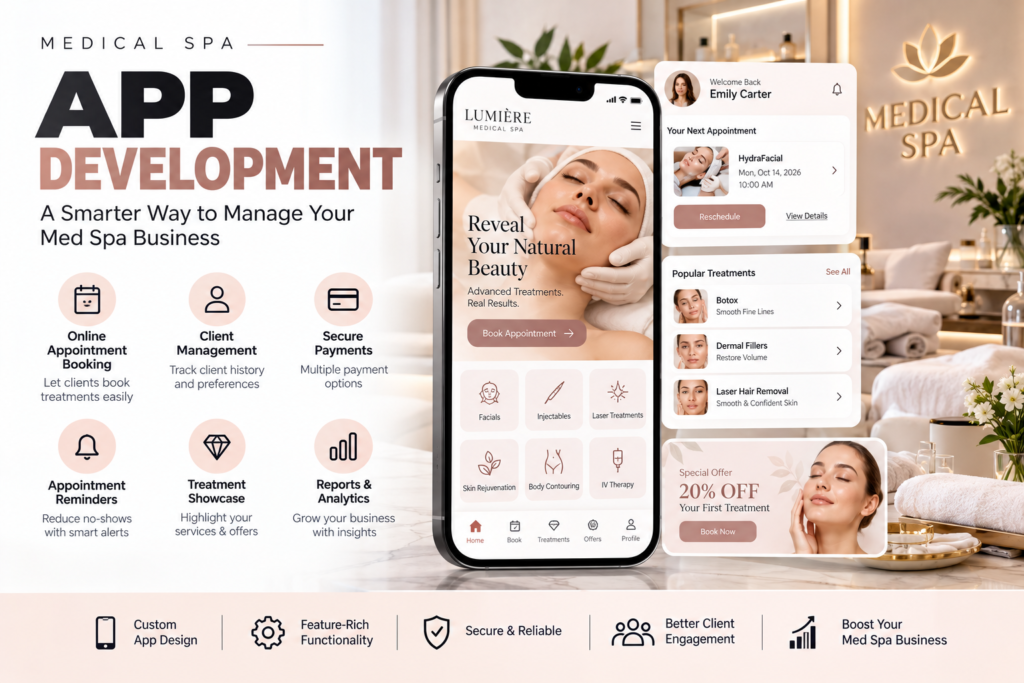
The medical aesthetics industry is becoming increasingly digital, with clients expecting convenient booking options, personalised communication and easy access to treatment information. For medical spas looking to improve the client experience and streamline daily operations, investing in digital technology can create valuable opportunities.
Medical Spa App Development helps businesses create mobile applications that allow clients to explore treatments, manage appointments, receive reminders and communicate with their clinic. Depending on the application’s functionality, it can also support staff workflows, customer relationship management and business administration.
Whether you operate a medical spa, an aesthetic clinic or a growing beauty and wellness business, a well-planned mobile app can make your services more accessible and help build stronger client relationships.
In this guide, we explore the essential features, key benefits, development considerations and practical steps involved in creating a successful medical spa application.
What Is Medical Spa App Development?
Medical Spa App Development is the process of planning, designing, building and maintaining a mobile application for a medical spa or aesthetics business.
The application can provide a digital platform where clients interact with the clinic without needing to rely entirely on telephone calls, emails or in-person visits.
Depending on the business requirements, a medical spa app may include:
- Online appointment booking
- Treatment and service listings
- Client profiles
- Appointment reminders
- Secure payments
- Loyalty and rewards programmes
- Push notifications
- Treatment preparation and aftercare information
- Staff and practitioner scheduling
- Administrative dashboards
Some applications focus primarily on client bookings, while others connect the customer-facing app with internal clinic management systems.
The right solution depends on your clinic’s size, services, budget and operational needs.
Why Is Medical Spa App Development Important?
Clients increasingly expect businesses to provide convenient digital experiences. A medical spa that makes booking and accessing information straightforward may be better positioned to meet these expectations.
Traditional booking methods can create challenges when staff need to answer calls, manage appointment changes, send reminders and respond to routine questions manually.
Medical Spa App Development can help address these challenges by bringing important services together in one accessible platform.
For example, clients could browse available treatments, review appointment times and manage bookings through their smartphones.
Meanwhile, clinic staff may benefit from improved scheduling, automated notifications and more organised client information.
A mobile app is not essential for every medical spa, but it can be a useful investment when it solves clear customer or operational problems.
10 Essential Features of Medical Spa App Development
1. Online Appointment Booking
Appointment booking is one of the most important features of a medical spa application.
Clients should be able to view available appointments and request or book a suitable time without unnecessary steps.
A convenient booking system may include:
- Treatment selection
- Practitioner selection
- Available appointment times
- Appointment confirmation
- Rescheduling options
- Cancellation policies
- Booking history
For example, a client interested in a facial treatment could select the service, review available times and confirm an appointment directly through the app.
The booking system should synchronise with the clinic’s scheduling platform where possible to reduce double bookings and administrative confusion.
A straightforward booking experience can remove friction from the customer journey and make it easier for interested clients to take the next step.
2. Treatment and Service Catalogue
Clients often want to understand their options before contacting a medical spa.
A well-organised treatment catalogue allows users to explore available services and find relevant information in one place.
Depending on the clinic, treatment pages might cover:
- Skin rejuvenation
- Facials
- Laser hair removal
- Chemical peels
- Microneedling
- Injectable treatments
- Body contouring
- Other aesthetic services
Each listing should provide clear information about what the treatment involves, consultation requirements, potential benefits, relevant limitations and pricing where appropriate.
Avoid promising guaranteed results or suggesting that every treatment is suitable for every person. Medical or aesthetic procedures may require an individual assessment by a qualified practitioner.
A clear catalogue helps clients understand the services offered and prepare informed questions before booking.
3. Personalised Client Profiles
Client profiles can make the application more convenient by allowing users to manage their account details and appointments.
Depending on the system, a profile may include:
- Contact information
- Upcoming appointments
- Previous bookings
- Preferences
- Payment records
- Loyalty points
- Consent status
If the application stores medical histories, photographs, treatment notes or other sensitive health-related information, the clinic must implement appropriate privacy, security and access controls.
Only collect information that is necessary for the intended service, and explain clearly how it will be used.
Personalised profiles can support a smoother client experience while helping the business organise routine interactions more efficiently.
4. Appointment Reminders and Push Notifications
Missed appointments can disrupt clinic schedules and reduce available treatment capacity.
A medical spa application can send appointment confirmations and reminders to help clients keep track of upcoming visits.
Useful notifications may include:
- Booking confirmations
- Appointment reminders
- Schedule changes
- Cancellation notifications
- Relevant preparation instructions
- Follow-up reminders, where appropriate
Clients should be able to manage notification preferences, and messages should avoid exposing sensitive treatment details on a locked screen.
Push notifications can also communicate general service updates or relevant offers when clients have provided the appropriate permission.
Used thoughtfully, reminders can improve communication without overwhelming clients with unnecessary messages.
5. Secure Payments and Deposits
Payment functionality can make the booking process more convenient for both clients and clinic staff.
Depending on the business model, Medical Spa App Development may include secure payment processing for:
- Appointment deposits
- Treatment bookings
- Gift vouchers
- Packages
- Memberships
- Eligible retail products
The app should clearly explain pricing, deposits, cancellation conditions, refunds and any recurring payment arrangements.
Use a reputable payment provider and avoid storing raw payment card details unnecessarily.
Payment processing should be designed with appropriate security measures and applicable legal requirements in mind.
A transparent payment experience can help clients understand their financial commitment before confirming an appointment.
6. Loyalty Programmes and Memberships
Loyalty programmes can encourage repeat engagement when they provide genuine value to clients.
A medical spa app might allow users to view membership benefits, track eligible rewards or access available offers.
Possible features include:
- Loyalty points
- Membership status
- Eligible discounts
- Treatment packages
- Referral rewards
- Birthday offers
- Voucher management
For example, a clinic could offer a membership that provides clearly defined benefits across eligible services.
The terms should be transparent, including any expiry dates, exclusions or restrictions.
Promotions should also comply with the advertising and professional rules applicable to the clinic’s services. Avoid incentives that encourage unnecessary medical or aesthetic procedures.
The objective is to improve customer convenience and encourage appropriate repeat engagement, not to pressure clients into treatments they do not need.
7. Treatment Preparation and Aftercare Information
Clients may need specific instructions before or after certain aesthetic procedures.
An app can provide convenient access to approved educational material, helping clients review instructions when needed.
Depending on the treatment, the information may include:
- Consultation requirements
- Preparation guidance
- General aftercare instructions
- Expected recovery considerations
- Warning signs that require professional advice
- Clinic contact details
All clinical information should be reviewed and approved by appropriately qualified professionals.
The app should not replace an individual consultation or be presented as a substitute for urgent medical care.
Where appropriate, clients should be able to contact the clinic if they have concerns or questions about their treatment.
This feature can support communication while helping clients access consistent information from their provider.
8. Secure In-App Communication
Clients may have questions about appointments, services or preparation requirements.
An in-app communication feature can provide a convenient way to contact the clinic without switching between multiple platforms.
Potential functionality includes:
- General enquiry messaging
- Appointment-related questions
- Customer support requests
- Follow-up communication
- Links to approved information
- Contact options for the relevant clinic team
If the app handles health information, the messaging system must be designed with appropriate confidentiality, access controls and data protection measures.
The clinic should also explain when messages are monitored and what clients should do if they require urgent medical assistance.
A clear communication channel can make it easier for clients to obtain routine information and understand their next steps.
9. Staff Scheduling and Administrative Dashboard
A medical spa application can also support the team behind the business.
An administrative dashboard may allow authorised staff to manage appointments, update treatment listings, review bookings and oversee day-to-day activity.
Depending on the system, features could include:
- Staff calendars
- Practitioner availability
- Appointment management
- Service and pricing updates
- Client communication tools
- Booking reports
- Permission-based staff access
- Basic performance analytics
For clinics with multiple practitioners or locations, a centralised dashboard can help organise schedules and reduce manual administrative work.
The dashboard should provide access only to information each staff member needs for their role.
A well-designed administrative system can make the app useful for the entire business rather than simply serving as a booking tool for clients.
10. Analytics and Business Reporting
Analytics can help medical spa owners understand how clients use the application and where improvements may be needed.
Useful measurements can include:
- App downloads
- Active users
- Booking completion rates
- Appointment cancellations
- Popular services
- Repeat bookings
- Notification engagement
- Revenue attributed to app bookings
For example, if many users view a treatment but leave before booking, the clinic could review the page’s information, pricing clarity or booking process.
Analytics should be interpreted carefully. An increase in app downloads does not automatically mean an increase in revenue or client satisfaction.
Collect only appropriate data, respect user privacy and use reports to make evidence-informed business decisions.
Key Benefits of Medical Spa App Development
The right application can support several business objectives.
Improved Client Convenience
Clients can access relevant information and manage appointments through a familiar mobile interface.
More Efficient Appointment Management
Online booking, confirmations and reminders can reduce some repetitive administrative tasks.
Better Client Communication
A centralised platform can make it easier to share appointment information and approved treatment guidance.
Stronger Client Relationships
Profiles, relevant reminders and useful service information can create a more consistent experience.
Support for Repeat Bookings
Convenient rebooking and transparent loyalty benefits can encourage clients to return when they choose to do so.
Greater Operational Visibility
Reporting tools can help business owners understand booking patterns and identify areas for improvement.
These benefits depend on how well the app is designed, implemented and adopted. An application should solve real problems rather than add unnecessary complexity to the business.
Medical Spa App Development vs a Medical Spa Website
A responsive website and a mobile application serve related but different purposes.
| Feature | Medical Spa Website | Medical Spa App |
|---|---|---|
| Discoverability through search engines | Strong potential | Usually more limited |
| Access without installation | Yes | Generally requires installation |
| Online appointment booking | Possible | Possible |
| Push notifications | Limited compared with native apps | Available where supported and permitted |
| Client account features | Possible | Possible |
| Repeat-use convenience | Browser-based | App-based |
| Development and maintenance | Varies by website | Can require additional investment |
| Best suited to | Discovery and general information | Frequent client interactions and ongoing services |
A website is often the best starting point for attracting new clients through search engines. An app may provide additional value for clinics with regular bookings, memberships or ongoing client interactions.
Some businesses may benefit from both, with the website helping people discover the clinic and the app supporting existing clients.
How Much Does Medical Spa App Development Cost?
The cost of Medical Spa App Development varies according to the complexity of the application and the services it needs to support.
Factors that can affect the budget include:
- Number of features
- iOS and Android requirements
- Custom design
- Appointment and calendar integrations
- Payment processing
- Client account functionality
- Health information handling
- Administrative dashboards
- Third-party software integrations
- Security and testing
- Ongoing maintenance
A basic booking application will generally require less work than a custom platform with memberships, complex clinic management integrations and sensitive health-data workflows.
Before requesting quotes, identify the most important features and distinguish essential requirements from future enhancements.
Ask developers to explain the proposed scope, delivery stages, ongoing support costs and ownership arrangements.
Important Security and Privacy Considerations
Medical spas may handle personal information and, depending on their services, sensitive health-related data.
Privacy and security should therefore be considered from the beginning of Medical Spa App Development, rather than added as an afterthought.
Important considerations include:
- Secure authentication
- Appropriate encryption
- Role-based access controls
- Clear privacy notices
- Data minimisation
- Secure payment processing
- Backups and recovery planning
- Software updates
- Security testing
- Appropriate data retention policies
For businesses operating in the UK, the handling of personal data may be subject to UK GDPR and the Data Protection Act 2018. Other jurisdictions may have additional or different requirements.
If the app processes health information, obtain appropriate legal and technical advice to establish the obligations that apply to your business.
How to Choose the Right Medical Spa App Development Company
Choosing a development partner is an important step.
Before hiring a company, consider the following factors.
Relevant Experience
Review examples of booking applications, healthcare-related platforms or customer-facing apps the team has developed.
Understanding of Your Business
The developer should understand your services, client journey and operational challenges.
User Experience and Design
Look for a clear interface, accessible layouts and a straightforward booking process.
Security Knowledge
Ask how the team will protect personal information and manage access to sensitive data.
Integration Capabilities
Check whether the app can connect to your existing calendar, payment provider or clinic management software.
Maintenance and Support
Confirm who will fix bugs, provide updates and support the application after launch.
Clear Pricing and Ownership
Understand what is included in the contract, who owns the code and design assets, and whether additional fees apply to future changes.
The right partner should help you prioritise useful functionality and build a platform that can evolve with your business.
Common Medical Spa App Development Mistakes to Avoid
Avoid these mistakes when planning your application.
Adding too many features at launch: Start with the functions that solve your biggest client and operational problems.
Ignoring user experience: Complicated registration and booking steps can discourage adoption.
Overlooking privacy: Sensitive information requires appropriate safeguards and clear handling practices.
Using unclear treatment information: Make service descriptions accurate, accessible and professionally reviewed.
Neglecting maintenance: Apps need updates, testing and ongoing support.
Ignoring accessibility: Design for users with different needs, devices and levels of technical confidence.
Building without measuring results: Define useful success metrics before launch.
A focused, secure and easy-to-use application is often more valuable than a complicated app that clients rarely use.
Ready to Invest in Medical Spa App Development?
A well-planned app can make booking more convenient, improve client communication and help your team manage routine tasks more efficiently.
If you are considering Medical Spa App Development, start by identifying the biggest challenges in your current client journey. Decide whether you need online booking, appointment reminders, client profiles, payment functionality or more advanced clinic management tools.
Ready to build a medical spa app tailored to your business? Contact our team today to discuss your goals, essential features, budget and development timeline.
We can help you plan a user-friendly application that supports your services, fits your operational requirements and provides a clear path for future improvements.
Final Thoughts
Medical Spa App Development offers medical spas an opportunity to create more convenient digital experiences for clients while improving selected business processes.
Features such as online booking, treatment catalogues, secure payments, reminders, client communication and administrative dashboards can help make an application useful for both customers and staff.
However, success depends on choosing the right features, creating a straightforward user experience and protecting personal information appropriately.
Before investing, assess your business needs, define a realistic budget and choose a development partner who understands usability, security and long-term maintenance.
With careful planning, a medical spa app can become a practical addition to your wider digital strategy.
Frequently Asked Questions About Medical Spa App Development
What is Medical Spa App Development?
Medical Spa App Development is the process of creating a mobile application that helps a medical spa manage client interactions, appointments, treatment information and selected business operations.
What features should a medical spa app include?
Common features include online booking, treatment listings, client profiles, appointment reminders, secure payments, aftercare information, messaging, loyalty programmes and an administrative dashboard.
How can a medical spa app benefit a business?
An app can make booking more convenient, support client communication, reduce some repetitive administrative tasks and provide useful information about booking activity.
How much does Medical Spa App Development cost?
Costs vary according to design complexity, platform requirements, integrations, security needs and feature scope. Request a detailed quote based on your requirements rather than relying on a single generic estimate.
Should a medical spa have an app or a website?
A website is important for online discovery and search visibility, while an app can be useful for frequent client interactions, bookings and account features. Some businesses benefit from using both.
Is online booking important in a medical spa app?
Online booking can help clients view appointment availability and manage reservations conveniently. The booking system should integrate appropriately with the clinic’s scheduling process.
Is Medical Spa App Development suitable for small clinics?
It can be, provided the application solves a genuine business need. A small clinic may start with a simple booking solution or a mobile-friendly website before investing in a more complex app.
How long does it take to develop a medical spa app?
The timeline depends on the features, design, integrations, testing and approval requirements. A simple app will generally involve less work than a complex platform with multiple systems and sensitive data.
How should a medical spa app protect client information?
Appropriate measures may include secure authentication, encryption, access controls, data minimisation, privacy notices, security testing and regular maintenance. Requirements depend on the information processed and the jurisdictions in which the business operates.
How do I choose a Medical Spa App Development company?
Review the company’s relevant experience, portfolio, design approach, security practices, integration capabilities, pricing, maintenance arrangements and ownership terms before signing a contract.