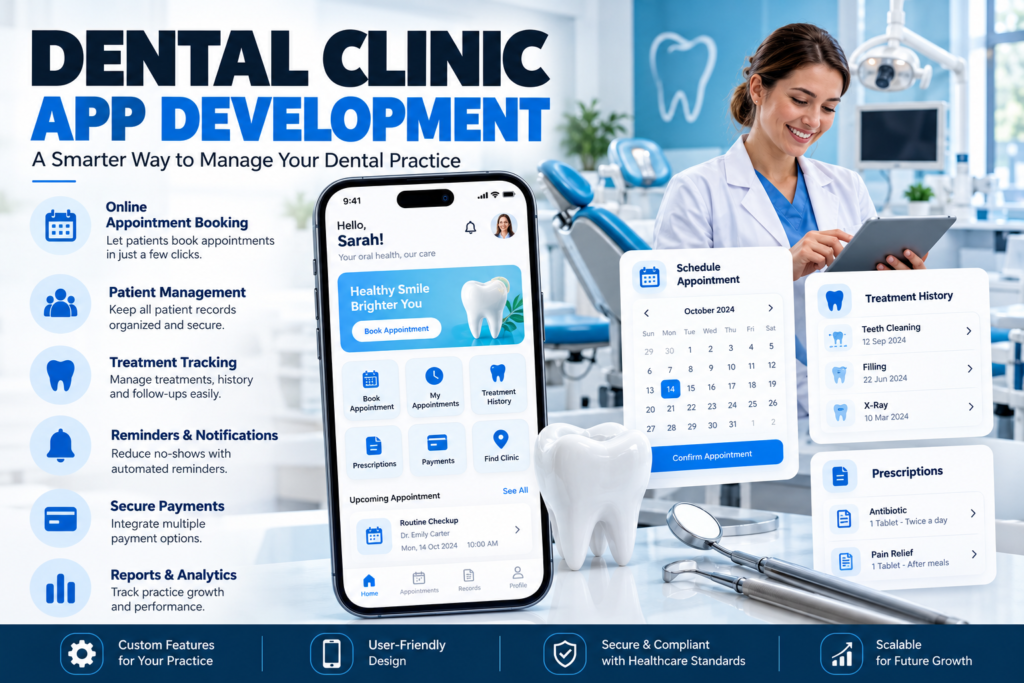
The dental industry is increasingly embracing digital technology to make healthcare more accessible, convenient and patient-focused. From booking appointments online to receiving treatment reminders and accessing dental information, digital tools are changing how patients interact with dental practices.
This is where Dental Clinic App Development can make a significant difference.
A well-designed dental clinic application helps patients manage appointments, communicate with dental professionals and stay informed about their oral health. For dental practices, it can also simplify administrative tasks, improve communication and support more efficient day-to-day operations.
Patients increasingly expect convenient digital services, and dental clinics can respond by offering technology that makes every stage of the patient journey easier.
In this guide, we’ll explore how Dental Clinic App Development improves patient experience, which features matter most and how dental practices can benefit from investing in a dedicated mobile application.
What Is Dental Clinic App Development?
Dental Clinic App Development is the process of designing and building mobile or web applications that help dental clinics manage patient interactions and deliver more convenient digital services.
Depending on the clinic’s requirements, an application may allow patients to:
- Book and manage dental appointments.
- Receive appointment reminders.
- View treatment information.
- Access selected dental records.
- Communicate securely with the clinic.
- Receive post-treatment instructions.
- Manage personal details.
- Make payments through supported payment systems.
- Access oral health education.
Some applications are designed primarily for patients, while others integrate with dental practice management systems to support both patients and clinic staff.
The main objective is to create a smoother, more accessible and more organised patient experience.
7 Powerful Ways Dental Clinic App Development Improves Patient Experience
1. Makes Appointment Booking Easier
Booking an appointment is often the first interaction a patient has with a dental clinic.
Traditional booking methods may require patients to telephone the reception desk during opening hours. This can be inconvenient for people with busy schedules or those who cannot call during the working day.
With Dental Clinic App Development, patients can use a mobile application to request or book appointments, depending on the clinic’s scheduling system.
Useful booking features can include:
- Available appointment slots.
- Appointment requests.
- Booking confirmations.
- Rescheduling options.
- Cancellation requests.
- Dentist or service selection.
A convenient booking process reduces unnecessary friction and helps patients manage their dental visits more easily.
For dental clinics, online appointment management can also reduce routine administrative work, although staff may still need to handle certain bookings and changes manually.
2. Reduces Missed Appointments With Automated Reminders
Missed dental appointments can disrupt clinic schedules and delay patient care.
Patients may forget an upcoming appointment or lose track of the date and time. Automated reminders can help address this problem.
A dental clinic application can send notifications before scheduled visits, depending on the features supported by the system.
For example, reminders may include:
- Appointment date and time.
- Clinic location.
- Dentist details.
- Instructions for preparing for a visit.
- Options for requesting a change.
Clinics can offer reminders through app notifications, email or SMS integrations where available.
These reminders help patients stay organised and give them an opportunity to contact the clinic if their plans change.
3. Improves Communication Between Patients and Dental Clinics
Clear communication is essential for a positive healthcare experience.
Patients may have questions about appointment arrangements, treatment instructions, costs or follow-up care. If communication is difficult, they may feel uncertain about what to expect.
Dental Clinic App Development can provide a central place for supported patient communications.
Depending on the application, features may include:
- Secure messaging.
- Appointment-related notifications.
- Treatment instructions.
- Frequently asked questions.
- Follow-up information.
- Contact details for the clinic.
For example, a patient who has received a treatment plan could use the application to review the information provided by the clinic.
Secure communication features should be designed with appropriate access controls and privacy protections. The application should also explain when patients need to telephone the clinic or seek urgent care rather than waiting for a message response.
4. Provides Convenient Access to Patient Information
Patients benefit when important information is easy to find.
A dental application may allow authorised patients to access selected information, such as appointment history, treatment plans, invoices or documents shared by their dental practice.
This can reduce the need to search through emails or contact reception for routine information.
However, the information available should depend on the clinic’s systems, professional policies and patient permissions.
A well-designed application should make it clear which records are available and how patients can request additional information when necessary.
It should also protect sensitive dental and personal information through appropriate security measures.
5. Supports Better Follow-Up Care
Patient experience does not end when a dental appointment finishes.
After certain procedures, patients may need instructions about oral hygiene, eating, medication prescribed by their clinician or follow-up appointments.
An application can make these instructions easier to access after leaving the clinic.
Useful features may include:
- Post-treatment care instructions.
- Follow-up appointment reminders.
- Oral hygiene guidance.
- Recovery information supplied by the dental team.
- Contact details for questions or concerns.
For example, a patient who has undergone a dental procedure could revisit the instructions provided by their dentist rather than relying on memory alone.
The content should be appropriate to the specific treatment and reviewed by qualified dental professionals.
An application should not replace clinical judgement or emergency services. Patients must have clear guidance on what to do if they develop concerning symptoms.
6. Makes Dental Services More Accessible
Convenience and accessibility are important parts of patient-centred healthcare.
Some patients may find it difficult to telephone during working hours, while others may benefit from clearer navigation, readable text or alternative ways to access information.
Dental Clinic App Development can help practices provide more flexible digital services.
Accessibility-focused features may include:
- Simple navigation.
- Readable text and adjustable font sizes.
- Clear appointment instructions.
- Accessible forms.
- Multiple language options where appropriate.
- Compatibility with assistive technologies.
- Mobile-friendly interfaces.
A good application should be designed for people with different levels of digital confidence and accessibility needs.
It should also offer alternative contact and booking methods for patients who do not use smartphones or prefer traditional communication.
7. Personalises the Patient Journey
Every patient has different dental needs, appointment schedules and treatment requirements.
A well-integrated dental clinic application can help patients access information relevant to their own care.
For example, the application may display upcoming appointments, reminders, clinician-provided instructions and relevant oral health resources.
Personalisation should be based on accurate information and appropriate patient permissions.
The objective is not to replace the dentist’s relationship with the patient. Instead, the application should support that relationship by helping patients stay informed and organised.
When used appropriately, personalised digital services can make interactions with a dental practice feel more relevant and convenient.
Essential Features to Include in Dental Clinic App Development
Choosing the right features is important when planning a dental application. The best solution depends on the clinic’s size, patient needs, existing software and budget.
Here are some features worth considering.
| Feature | Purpose | Patient Benefit |
|---|---|---|
| Online appointment booking | Allows patients to request or book appointments | Greater convenience |
| Appointment reminders | Sends notifications before visits | Helps reduce forgotten appointments |
| Patient profiles | Stores relevant information securely | Easier access to personal details |
| Treatment information | Displays clinician-provided treatment details | Better understanding of care |
| Secure messaging | Supports appropriate communication | Easier access to clinic information |
| Digital forms | Allows forms to be completed electronically | Less paperwork |
| Payment integration | Supports eligible online payments | More convenient transactions |
| Follow-up reminders | Helps patients manage future visits | Better continuity |
| Oral health resources | Provides educational information | Supports informed self-care |
| Accessibility features | Improves usability for different users | More inclusive access |
Clinics should prioritise features that solve genuine patient problems rather than adding functionality simply because it is available.
How Dental Clinic App Development Benefits Dental Practices
Although patient experience is the main focus, dental applications can also improve practice operations.
Reduced Administrative Work
Appointment requests, reminders and digital forms can reduce some repetitive tasks performed by reception staff.
The actual time saved depends on how well the application integrates with the clinic’s existing systems.
Better Appointment Management
A central booking interface can help patients manage their appointments while giving staff a clearer view of scheduling requests.
Integration with the clinic’s calendar is particularly important to prevent conflicting bookings.
Improved Patient Engagement
Notifications and accessible treatment information can help patients stay connected with their dental practice between appointments.
More Organised Communication
A dedicated application can bring selected patient communications and appointment information into one place.
Better Understanding of Patient Needs
With appropriate consent and privacy safeguards, aggregated application data can help clinics identify common usability issues, booking difficulties and patient service preferences.
Any analysis of patient information should follow applicable privacy and data protection requirements.
Dental Clinic App Development and Patient Data Security
Dental applications may handle sensitive personal and health information. Security should therefore be considered from the beginning of the development process.
Important measures can include:
- Secure authentication.
- Appropriate role-based access controls.
- Encryption of sensitive information.
- Secure data storage and transmission.
- Regular security testing.
- Reliable backup and recovery procedures.
- Clear privacy notices.
- Appropriate consent management.
- Secure integration with existing dental systems.
For clinics operating in the UK, the application should be designed to meet applicable data protection requirements, including the UK GDPR and Data Protection Act 2018 where relevant.
Clinics should also establish clear procedures for handling patient information, managing access requests and responding to potential security incidents.
Security should not be treated as an optional feature added after development. It is a fundamental requirement for a trustworthy healthcare application.
How to Choose the Right Dental Clinic App Development Company
Selecting an experienced development partner can help ensure that the application meets the needs of both patients and dental professionals.
Before choosing a provider, consider the following factors.
1. Healthcare Technology Experience
Look for a development team that understands healthcare workflows, patient communication and sensitive information.
2. User-Friendly Design
The application should be easy to navigate, with straightforward booking processes and clearly presented information.
3. Integration Capabilities
Ask whether the application can integrate with your existing appointment scheduling or dental practice management software.
4. Security and Privacy
Understand how patient data will be stored, accessed, protected and managed.
5. Scalability
Choose an architecture that can support additional features and a growing number of patients if required.
6. Ongoing Support
Ask about maintenance, software updates, bug fixes, security monitoring and technical support after launch.
7. Transparent Costs
Request a clear breakdown of development, integration, hosting, maintenance and third-party service costs.
A reliable development partner should explain the options clearly and recommend features based on your clinic’s actual needs.
How Much Does Dental Clinic App Development Cost?
The cost of Dental Clinic App Development varies according to the complexity of the application and the services it needs to provide.
Factors that influence the budget include:
- Number of features.
- Design requirements.
- Android and iOS support.
- Web application requirements.
- Integration with dental practice software.
- Payment processing.
- Security requirements.
- Data migration.
- Testing.
- Hosting and maintenance.
A simple appointment-booking application will generally require a different budget from a comprehensive platform with secure messaging, patient records, payment functionality and multiple software integrations.
Rather than choosing a development company based on the lowest quote, assess the total cost of ownership, security standards, usability and ongoing support.
Common Mistakes to Avoid During Dental Clinic App Development
Dental practices can improve their chances of success by avoiding several common mistakes.
Overcomplicating the application: Too many features can make an app difficult to use. Start with the functions patients need most.
Ignoring patient feedback: Ask patients and clinic staff about the problems they want the application to solve.
Overlooking accessibility: Design the application for different devices, abilities and levels of digital confidence.
Neglecting data security: Protect sensitive patient information throughout the application’s lifecycle.
Failing to test integrations: Verify that booking and patient information synchronise correctly with existing systems.
Ignoring ongoing maintenance: Applications require updates, testing and support after launch.
Making unsupported medical claims: Patient education should be reviewed by qualified dental professionals and should not replace individual clinical advice.
Final Thoughts: Why Dental Clinic App Development Matters
Dental Clinic App Development can improve patient experience by making appointment booking easier, reducing forgotten visits, supporting communication and providing convenient access to relevant dental information.
For dental practices, a thoughtfully designed application can also reduce some administrative work, improve appointment management and support more organised patient interactions.
However, successful development involves more than creating a mobile application. It requires an understanding of patient needs, accessible design, reliable integrations and strong data security.
The most effective solution is one that makes everyday tasks simpler without creating unnecessary complexity for patients or clinic staff.
Ready to Improve Your Dental Practice With a Custom Application?
If your dental clinic wants to provide a more convenient digital experience, start by identifying the challenges your patients face most often.
Work with an experienced Dental Clinic App Development team to plan the right features, design a user-friendly interface and integrate the application with your existing systems where appropriate.
Contact a dental app development specialist today to discuss your requirements, explore suitable features and create a digital solution that helps your patients connect with your practice more easily.
FAQs About Dental Clinic App Development
What is Dental Clinic App Development?
Dental Clinic App Development is the process of creating mobile or web applications that help dental practices provide digital services such as appointment booking, reminders, patient communication and access to selected dental information.
How does Dental Clinic App Development improve patient experience?
It can make booking appointments easier, provide timely reminders, support communication and help patients access relevant treatment information conveniently.
What features should a dental clinic app include?
Common features include appointment booking, reminders, patient profiles, digital forms, secure messaging, treatment information and payment integration where appropriate.
Can a dental clinic app reduce missed appointments?
Automated reminders can help patients remember upcoming appointments. However, the impact depends on how the system is implemented and how patients use it.
Is patient data secure in a dental clinic app?
It can be protected through appropriate authentication, encryption, access controls, secure storage and regular testing. Clinics should ensure the application meets applicable data protection requirements.
Can a dental app integrate with existing practice management software?
Potentially, yes. Integration depends on the software provider, available interfaces and the application’s technical requirements. Confirm compatibility before development begins.
How much does Dental Clinic App Development cost?
Costs depend on the required features, platforms, integrations, security requirements and ongoing maintenance. A detailed project specification is needed for an accurate quote.
How long does it take to develop a dental clinic app?
The timeline depends on the application’s complexity, design, integrations, testing and approval process. A basic application generally requires less development time than a comprehensive patient platform.
Can a dental clinic app support patient retention?
Convenient booking, helpful reminders and accessible communication may encourage patients to stay engaged with their practice. Results depend on the quality of the service and the needs of the patient population.
Why should a dental clinic invest in a custom application?
A custom application can be designed around the clinic’s workflows, patient needs and existing systems. It may be worthwhile when off-the-shelf software does not provide the required functionality or integration.